The Backyard Review
Why the Critters Keep Coming Back — and the Humane Fix That Finally Helps
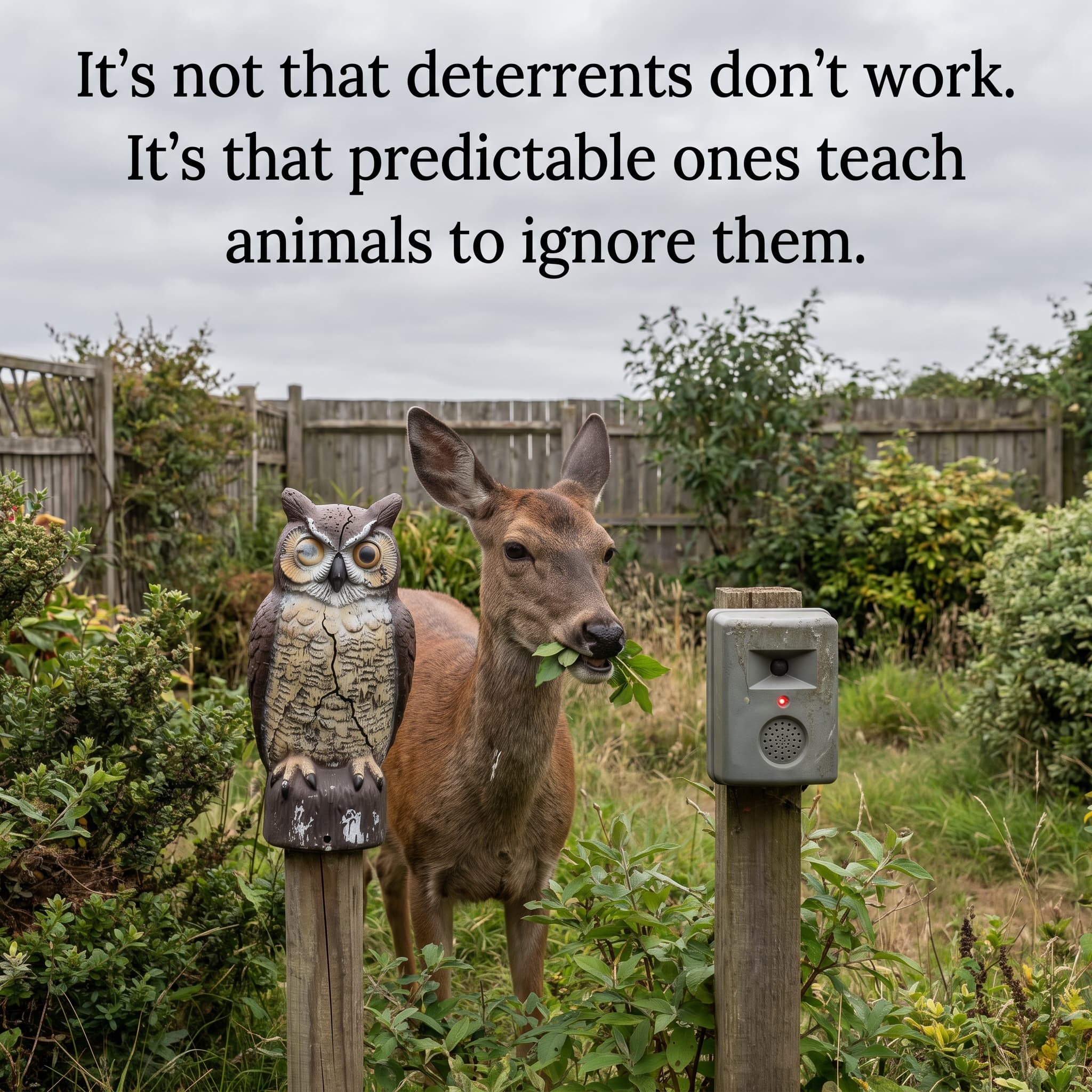
There's a particular kind of heartbreak that only gardeners understand.
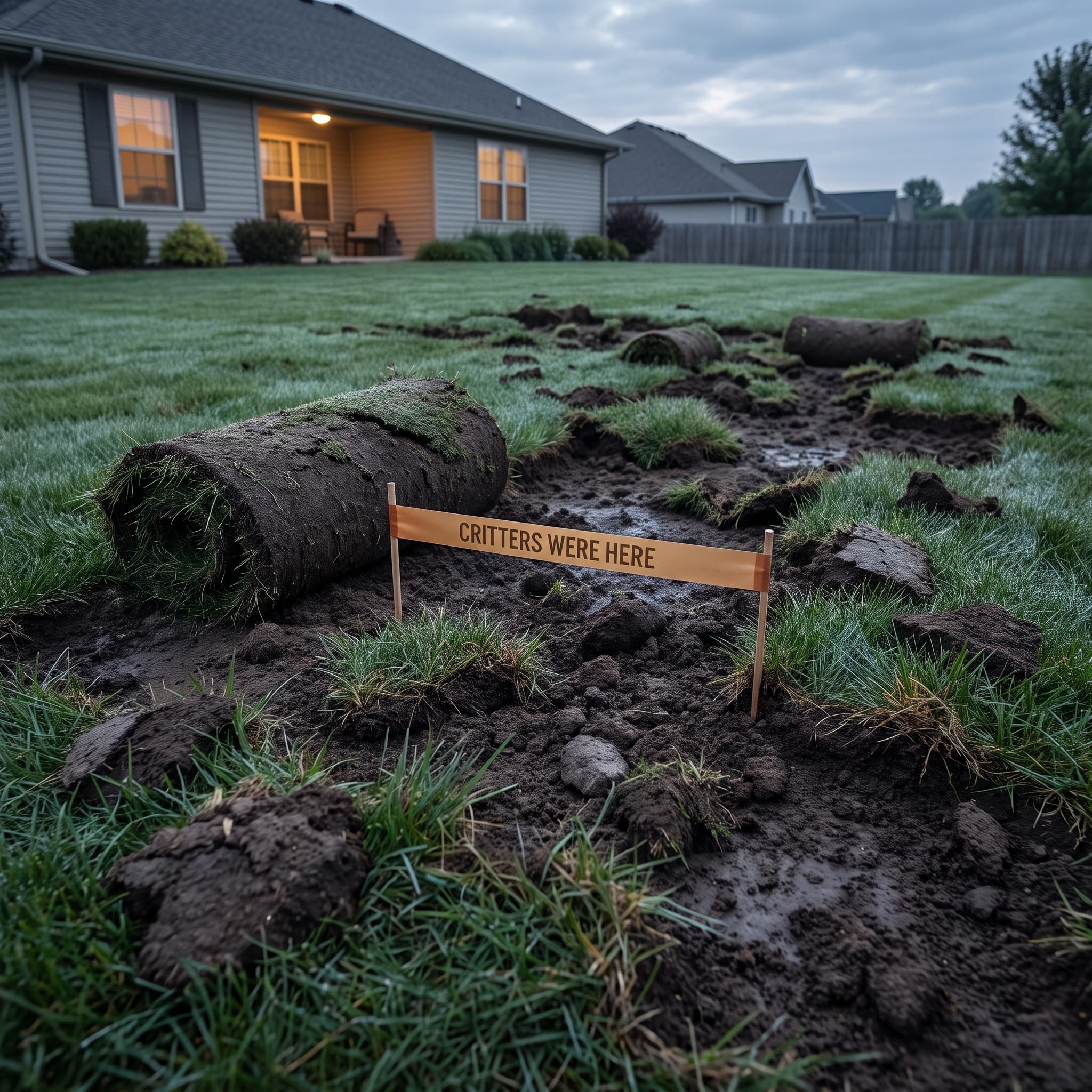
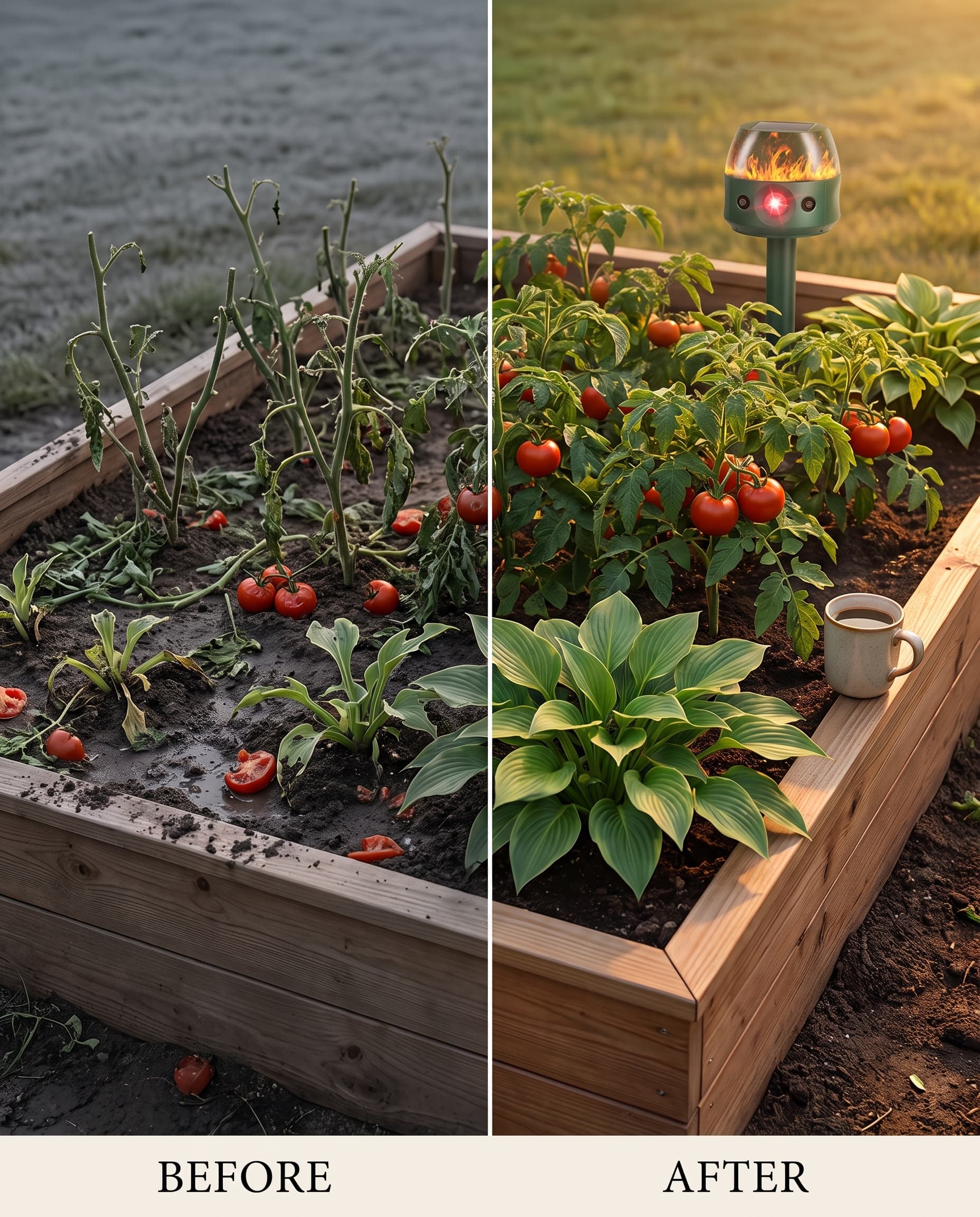
You spend the spring on your knees in the dirt. You water, you weed, you baby the tomatoes and the hostas and the little row of beans you've been watching climb. And then one morning you walk out with your coffee — the same walk you look forward to every day — and it's gone. Tops chewed off. Nothing but stalks. Flower beds trampled. The lawn peeled back "like a carpet" where something dug for grubs all night.
One gardener I spoke to called her yard "a crime scene." Another just kept muttering "those darn deer." If you've felt that specific mix of anger and helplessness — this was mine, and something wild just helped itself to it — you already know why people get a little obsessed with finding a fix.
And if you're like most of us, you have tried to fix it. Which is exactly why you're skeptical right now. Good. You should be. Let me tell you what I got wrong for three seasons straight.
It's Not You — And It's Not That Deterrents "Don't Work"
For the longest time I assumed I was doing something wrong. Wrong spray. Wrong spot. Not enough of it. I'd stand in the yard at dusk feeling genuinely defeated, thinking "what am I missing here?"
Here's the first thing that took the weight off my shoulders: you're not doing it wrong, and you're not imagining that this keeps happening. The animals really are coming back. And it's not because deterrents are useless — plenty of them startle animals just fine on night one.
The problem is what happens on night eight.
Because make no mistake — doing nothing isn't an option, and it doesn't stay the same. A yard that gets raided once is a yard that's now on the route. Raccoons have excellent memories; deer follow the same paths back to a reliable meal. Left alone, tonight's nibble becomes next week's buffet. So the real question was never "should I do something?" It was "why does everything I do stop working?"
I finally got the answer from a wildlife-nerd neighbor. It has a name.
The Hidden Reason Everything Eventually Fails: Habituation
Habituation is the scientific word for a simple, maddening thing: animals learn.
The first time a deer meets a new smell, a strange sound, or a flashing light, it does exactly what you hoped — it spooks and leaves. But animals are survival machines. The second night, it's a little less scary. By the third or fourth, the deer has quietly filed it under "annoying, but nothing bad ever actually happens." And once an animal decides a deterrent is harmless, it walks right past it — as one frustrated reviewer put it, "as if it isn't there."
This isn't a fringe theory. Wildlife researchers and university extension offices have documented it for decades. Field trials have found deer can grow used to a scare device in as little as a week. The stimulus is still going off — the animal has simply learned to ignore it.
Read that again, because it reframes everything: the reason your deterrent failed usually isn't that it was too weak. It's that it was too predictable. A single smell. A single sound. A single unchanging light, in the same spot, every night. You didn't buy a bad product. You bought a predictable one — and predictability is precisely what animals are built to outlast.

Why Every Fix You've Already Tried Was Doomed to the Same Fate
Once habituation clicked for me, my whole graveyard of failed solutions suddenly made sense. Look at the pattern:
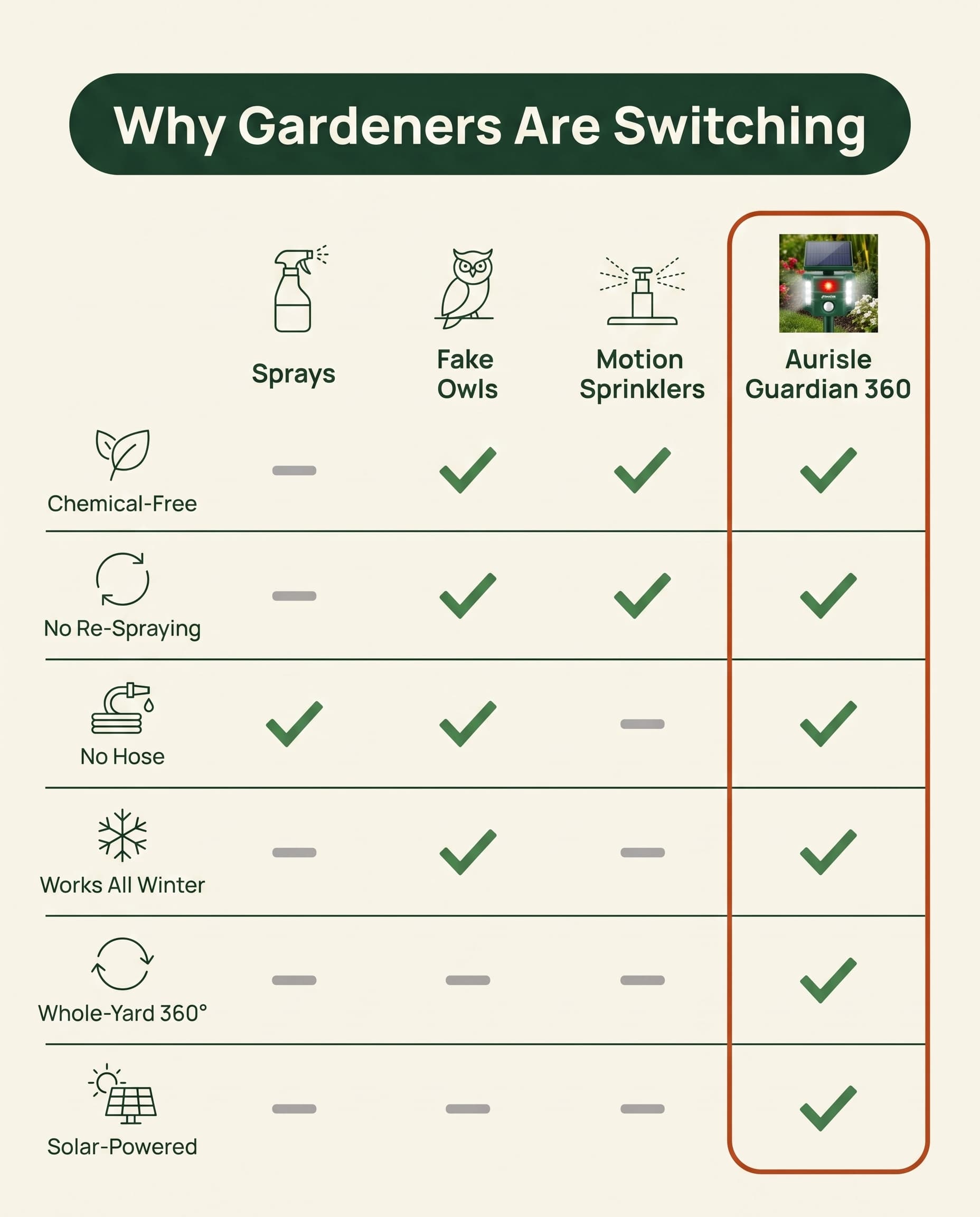
- Repellent sprays. They can work — until it rains and they wash off, or until you forget the every-two-week reapplication, or until the deer simply gets used to the smell and eats around it. It's a chore that expires. And who wants to keep spraying chemicals near the vegetables they're planning to eat?
- Fake owls and plastic predators. They never move. A crow figures that out in an afternoon; a deer figures it out by the second night. A threat that never does anything stops being a threat.
- Cheap ultrasonic gadgets. Here's the real flaw: most drone the same tone, nonstop, from the same corner, 24 hours a day. That constant hum is a habituation machine — the animals tune it out within days, and it can quietly become a nuisance for your own household in the meantime. (It doesn't help that plenty are the kind of "cheap junk" that stops charging after a week, either.) The problem was never the idea of sound — it was pumping out one predictable sound around the clock.
- Motion sprinklers. Genuinely more startling, because water is a real consequence — but they need a hose trailing across your yard, they only guard one narrow zone, and they freeze solid the moment temperatures drop, so they're useless for a big chunk of the year.
See the through-line? Every one of them fails for the same reason: it's predictable, single-note, or high-maintenance — or all three. They give the animal one fixed thing to learn and then ignore.
Which finally pointed me toward the real question — the one that actually matters:
If predictability is the problem, what would an unpredictable solution even look like?
It would have to do the opposite of everything above. It couldn't drone constantly — it would have to stay quiet until something actually showed up, so it never becomes background noise. It couldn't rely on one trick — it would need to hit several senses at once and keep changing them, so animals never get a stable pattern to memorize. And it couldn't guard one tiny patch — it would have to watch the whole yard, powered in a way I'd never have to babysit.
That was the checklist. I didn't expect anything to actually meet it. Then I found the one that was built around this exact idea — the Aurisle Guardian 360™ — and for the first time in three seasons, my morning walk stopped being a damage report.
Meet the Deterrent That's Built to Never Repeat Itself
Remember the checklist habituation forced me to write? Stay quiet until something shows up. Hit several senses at once and keep changing them. Watch the whole yard. Don't make me babysit it.
The Aurisle Guardian 360™ is the first thing I found that was designed around that exact problem instead of ignoring it. Here's what makes it different — and I'll say up front, no gadget is a magic force field, and any honest one will tell you the same. But this is the most sensible answer to habituation I've come across:
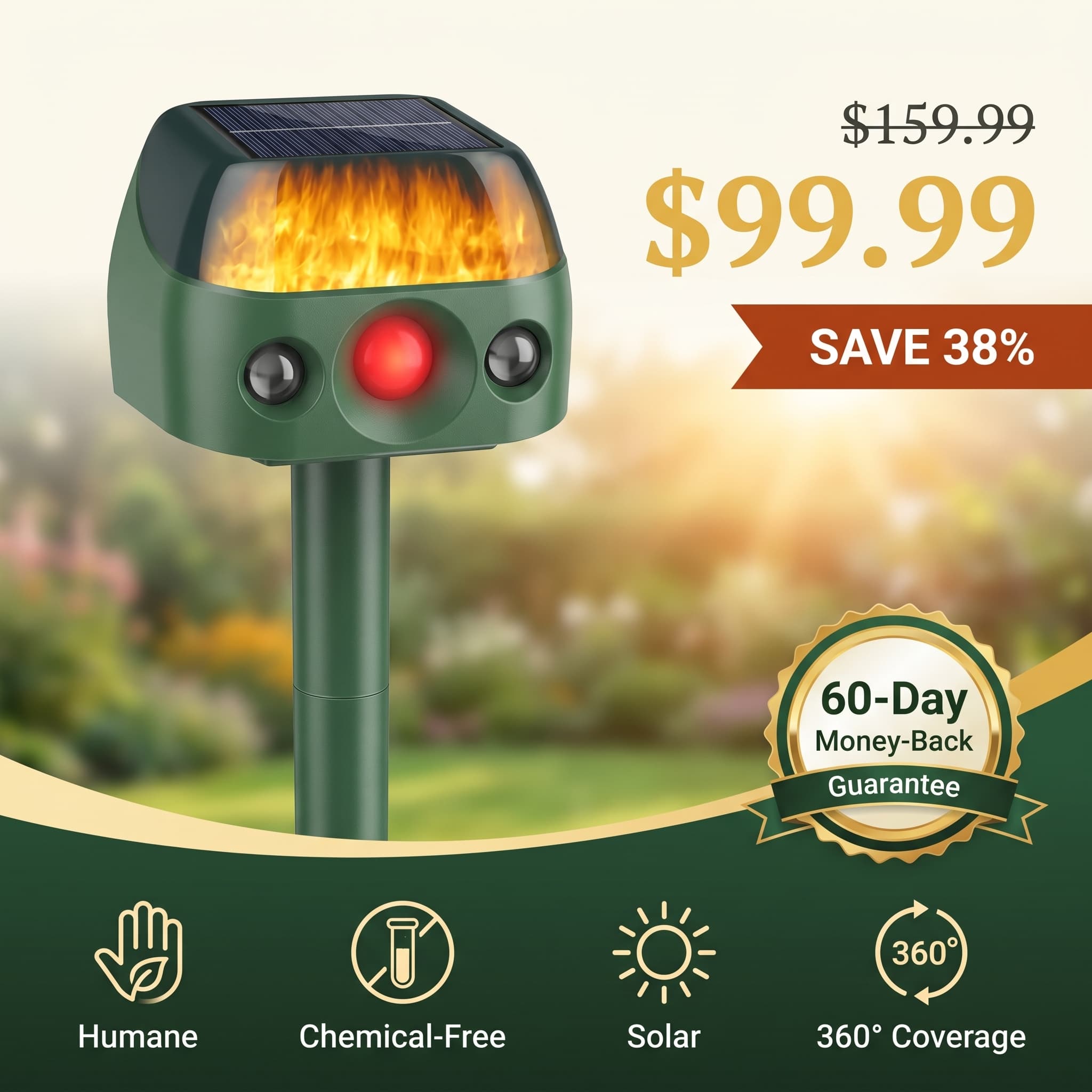
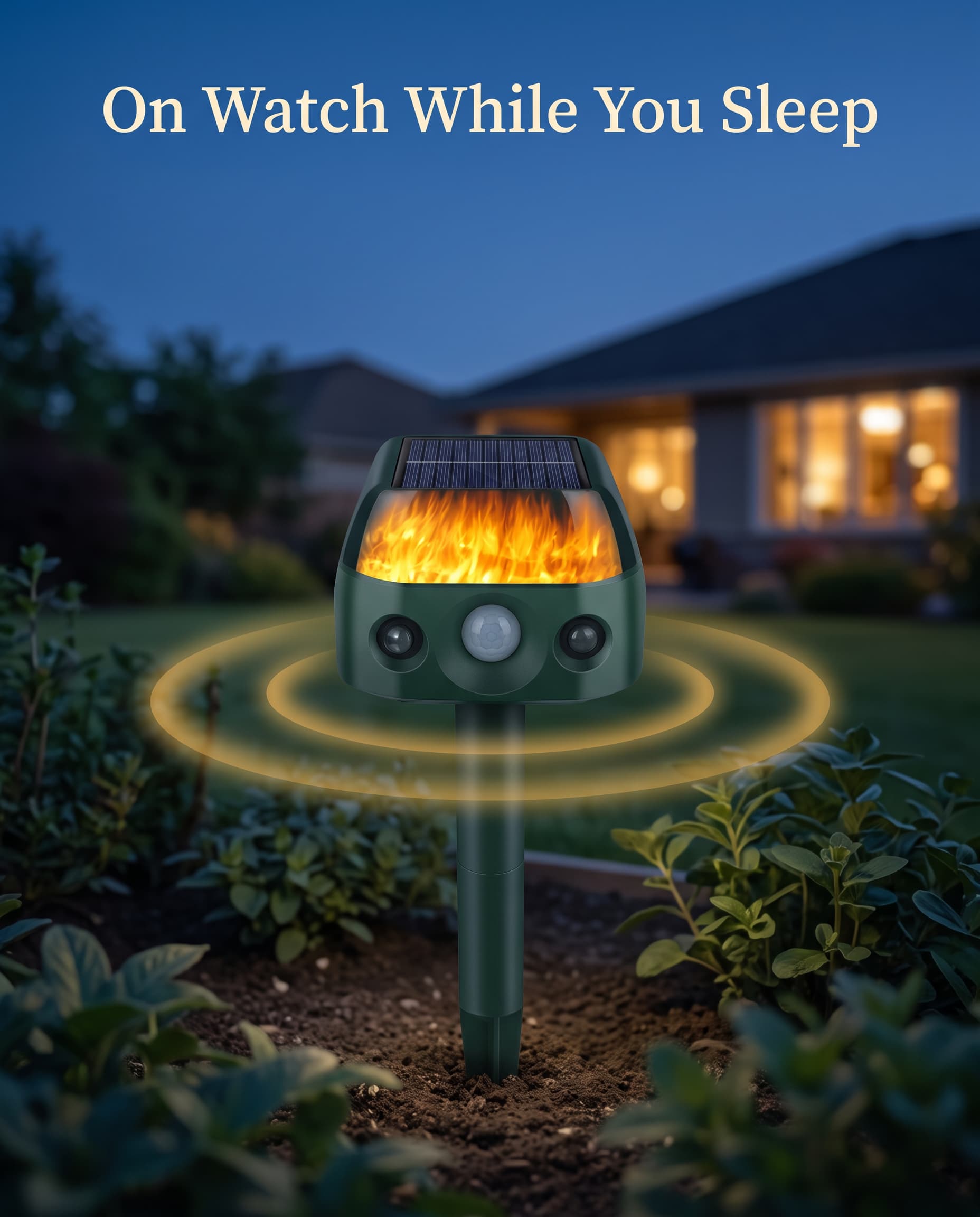
- It stays silent until something enters the yard. This is the key difference from the cheap gadgets: a PIR motion sensor means it isn't droning 24/7 from the corner. Instead of a constant tone — the kind animals file under "harmless" and households learn to hate — it reacts in short bursts only when something actually trips the sensor, then goes quiet again. Nothing to tune out, and nothing humming in your yard all day.
- It hits multiple senses — and rotates them. Instead of one fixed trick, it cycles through several deterrent modes: an ultrasonic burst, sudden flashing LEDs, and a flickering flame-effect light designed to mimic the movement of fire — one of the oldest "stay away" cues in the animal world. Because the response keeps changing, there's no single stable pattern to memorize and tune out.
- It covers in every direction, not one narrow strip. Each unit watches a full 360° zone around it — no hose, no aiming a single jet at one gap while the animals stroll in from the other side. For a bigger property, you add units to cover the whole yard (more on that below).
- It runs on the sun and asks nothing of you. Solar-powered, weatherproof, always charged, always on watch. No batteries to swap, no spray to reapply, no bringing it indoors before the first frost.

That's the whole idea in one line: the others gave animals one thing to get used to. This one is designed to stay unpredictable. That's not a louder claim than the competition — it's a smarter one.

Finally — Protection That Doesn't Mean Poison, Traps, or Guilt
Here's the part that actually sealed it for me, and I suspect it will for you too.
I never wanted to hurt anything. Most gardeners don't. We say "I just want them gone" — not gone as in harmed. The whole reason the animal problem is so maddening is that the usual "serious" solutions ask you to cross a line you don't want to cross:
- Poisons and rodenticides near the very vegetables you're growing to eat — around your pets, around your grandkids.
- Traps that are grim to check, and worse to empty.
- Chemical sprays soaking into the soil of a garden you started because you wanted something cleaner.
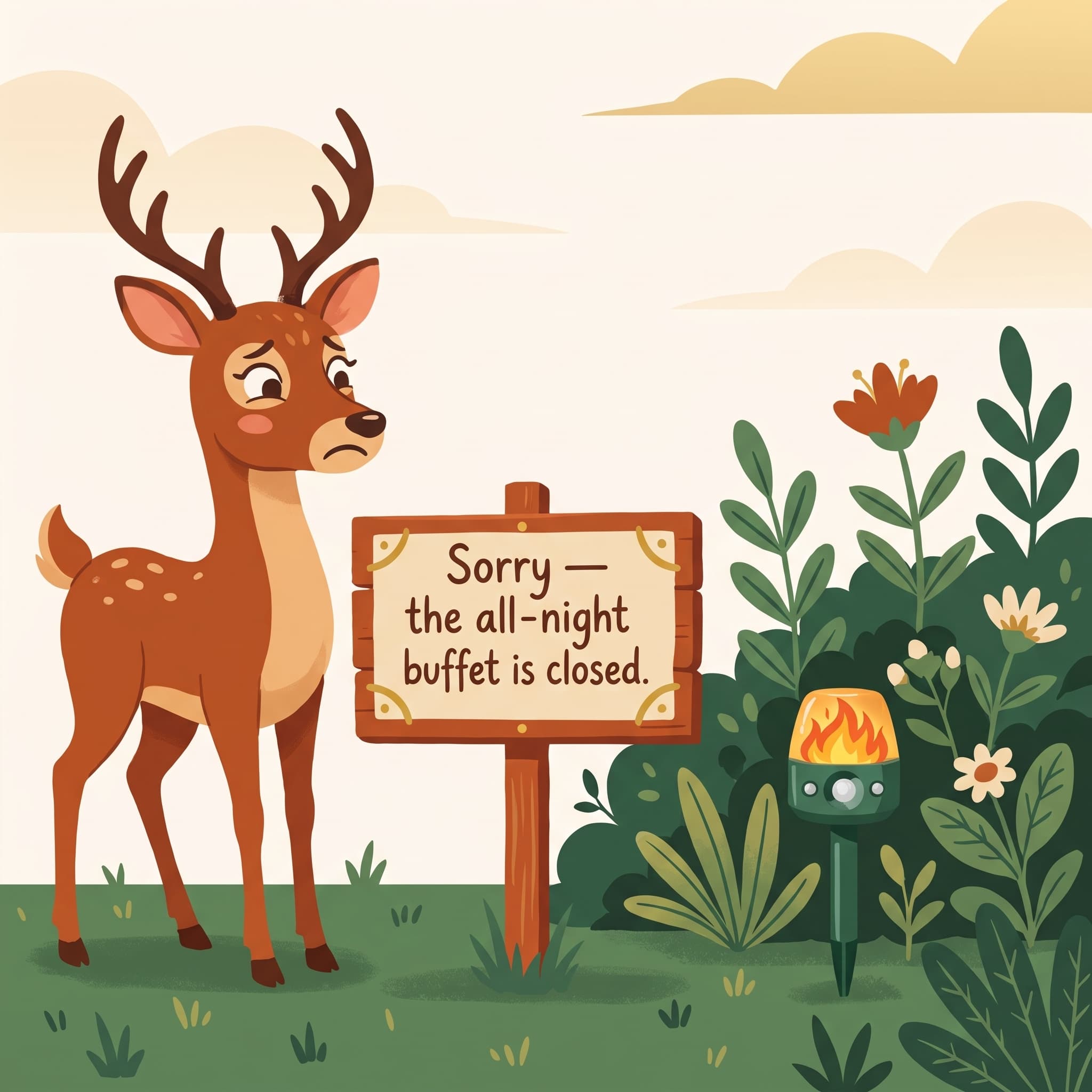
The Guardian 360 sidesteps all of it. Nothing toxic touches your beds. Nothing gets caught, hurt, or killed. It simply makes your yard an annoying, unpredictable place to be — so the animals decide, on their own, to go bother someone else. You protect what you grew and you keep your conscience clean. For a lot of us, that isn't a bonus feature. It's the whole point.
Built to Be Kept — Not Left in the Garage
There's a quiet reason most yard gadgets fail that has nothing to do with animals: people stop using them.
The spray is a chore, so it lapses. The sprinkler needs the hose dragged out, so it sits in the shed. The cheap repeller dies in a week, so it's in a drawer by August. A solution you don't keep running is a solution that can't help you.
The Guardian 360 was made to actually stay in service. Stake it in the ground, let the sun keep it charged, and it just… stands watch. No refills, no re-aiming, no seasonal teardown. It's the difference between something you bought and something you'll actually still be using next spring — which, in the end, is the only kind of protection that counts.
What This Is Really Worth (Run the Numbers)
I put off buying a "premium" one for a long time because there are $20 gadgets all over the internet. Then I added up what my cheap route had actually cost me. Run the numbers and it gets uncomfortable:
| A season of ruined tomatoes, hostas & landscaping | $300+ |
| Deer fencing for a modest yard (plus install) | $600+ |
| Repellent sprays, re-bought all season, every season | $75/yr, forever |
| The graveyard of $20 gadgets that quit in a week | "in the trash" |
| Aurisle Guardian 360™ — solar, whole-yard, no refills | $99.99, season after season |
The cheap stuff isn't cheap. It's expensive in installments — a little money and a lot of lost harvest, paid again every year. The whole point of a premium build is that you buy it once and it keeps standing guard, instead of quietly failing you at the worst possible moment.
And because I know you've been burned before, here's the part that made trying it a no-brainer.
Hear From Real Gardeners

Ready to Reclaim Your Mornings?
With the Aurisle Guardian 360™, you're one setup away from walking out with your coffee and finding your garden exactly the way you left it — no chemicals, no traps, no chore, no guilt.

Not Another Throwaway Gadget
If you've been burned by cheap repellers that died in a week or crawled here on a slow boat, read this before you decide:
- Backed by our 60-day money-back guarantee. Try it in your own yard. If you're not glad you did, you're covered — the risk is on us, not you.
- Real human support. Questions or issues reach actual people who answer — not a dead inbox you never hear back from.
- Built for the outdoors. Weather-resistant housing made to live outside and keep standing watch, season after season.
- Tracked delivery & easy returns. Straightforward shipping and a no-hassle return process — no guessing games.
Aurisle Guardian 360™ — Solar 360° Yard Guardian
- Stays quiet until something enters — then responds
- Rotating multi-sensory modes, built to stay unpredictable
- Full 360° coverage per unit — add units to guard the whole yard
- Solar-powered — no hose, no refills, no battery swaps
- Humane & chemical-free — nothing poisoned, nothing trapped
- Free shipping — delivered to your door
- 60-Day Guarantee — love it or your money back